Fortune 500 revenue here, won’t get you there

The speed and pace of change demands business act, respond, and accomplish so much more, with so much less. HubSpot CEO, Brian Halligan, presents the following:

> In 1983, of the 1,000, largest American companies, by 1993, 811 remained
> In 2003, of the 1,000 largest American companies, by 2013, 243 remained

That change happens is constant reality. Now constant change accelerates the decade of decay. Demand for new revenue demands new business models and human capital competency.

In 2010 I wrote a post on Fortune 500 turnover, that simple math called almost 50%. What if the period took too much hit from the dot com bubble to provide a good source, in this post I revisit those numbers and look at 2013 and 2014 Fortune 500 numbers as well.

Time’s up for merger and acquisition synergy

The mergers and acquisitions world sprinkles potential deals with a bit of pixie dust called synergy. Synergy is neither rational, functional, nor logical.

If HR used the word synergy in an accounting meeting? Laughed out of the room. If HR or human capital used the word synergy in a corporate finance discussion? The time value of money, that is rational. What will it cost? What return will it realize? When will it realize that return? All rational.

Synergy? Synergy is more a pagan fairy than rational way to make a deal.

Mergers and acquisitions failures are project management failures

Mergers and acquisitions failures are really business strategy project management failures

No matter the motive for a merger or acquisition the real work comes with integration.

Similar to a project scope statement that identifies the success criteria for a project, the only way to identify success or failure is within the scope of the M&A goals.

Subsequently, the risk in mergers and acquisitions comes down to the ability of a team to deliver within budget, by a certain time, and up to project expectation (scope) and project failure rates for M&A deals are strikingly high.

Mergers and acquisitions systems thinking strategies, part 2

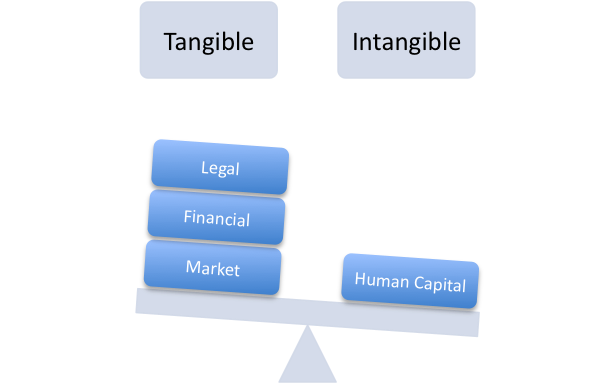
When evaluating merger integration risk the reality is true integration risk identification can only happen with an evaluation of systems integration. Without front-end, due diligence on human capital integration then too often the deal becomes a post-merger write-off. The result: wasted opportunity, multiples on paper only, and “synergies” left back on the deal table or with the executive hand-shake.