
CEOs care about learning programs. To gain more executive-level interest, guess what learning and development folks? CEOs want metrics. Give them learning metrics.
The learning metrics you may have collected and reported on might need adjustment to become important to an executive.
The organization challenge that leader’s need to recognize is that an organization’s ability to learn and to adapt is the only source of competitive advantage.
Development professionals only gain stature in the business environment when they meet and plan business solutions.
The ROI Institute and Chief Learning Officer magazine have a study recap [link no longer available, sadly] that should provide a clearer map of our worth. The targets of this survey were CEOs at Fortune 500 companies and the top 50, privately held firms. From this population 450 firms received a survey and 95 firms, 21%, responded.
Quick hits:
- 4% of CEOs avoid learning and development investments
- 20% of CEOs invest in only the minimum
- 10% of CEOs invest in all learning and development needs
- 18% of CEOs invest when they see value
The survey further landed the learning and development environment reality in the results to determine how close the CEO works with their lead learning and development (L&D) executive. To assess this, the survey asked CEOs to check:
- Number one bullet, to indicate the L&D executive reports direct to the CEO;
- Number two bullet, if there are two levels between them; and
- Number three bullet, if there are three levels between the CEO and the L&D lead
The average response: 3.2, meaning the CEO is more than three levels removed from their L&D executive.
The chart below provides the greatest opportunity to get into, or stay in, the business discussions with CEOs. Along the left column one through eight signify metrics currently in use:
- Numbers one and two are process measures or inputs to the process;
- Numbers three through seven are roughly mapped to classic levels of evaluation*; and
- Number eight for the awards achieved from, typically, bigger organizations
The column on the far right lands the case for change in our relevance: impact and ROI. Impact and ROI are number one and number two in “ranking of the importance of this measure”.

CEOs are telling us they want details on learning and development mapped to:
- Business strategy impact and
- ROI
What are we reporting? Let’s take a look at learning and development scorecards. Though the survey reveals only 22% of CEOs said there was a development scorecard or had seen one, of those, only one CEO indicated pleasure with their current scorecard. Comments from the 22% include:
- “inadequate”
- “incomplete”
- “doesn’t have all the data”
- “doesn’t really connect to the business” [emphasis added]3
Learning Metrics
The first rule in communication: know your audience.
If we were unsure before or banging our heads against the wall looking for an opportunity, we now have gold to work with from these results.
Consider these results as if you had a direct conversation with your CEO. Consider what is relevant for the CEO’s need to understand. Have you justified the budget that classroom training is only about 20% of learning?
An organization’s ability to learn and to adapt is the only source of competitive advantage. Our ability to become, or remain, relevant also comes down to an ability to learn and adapt.
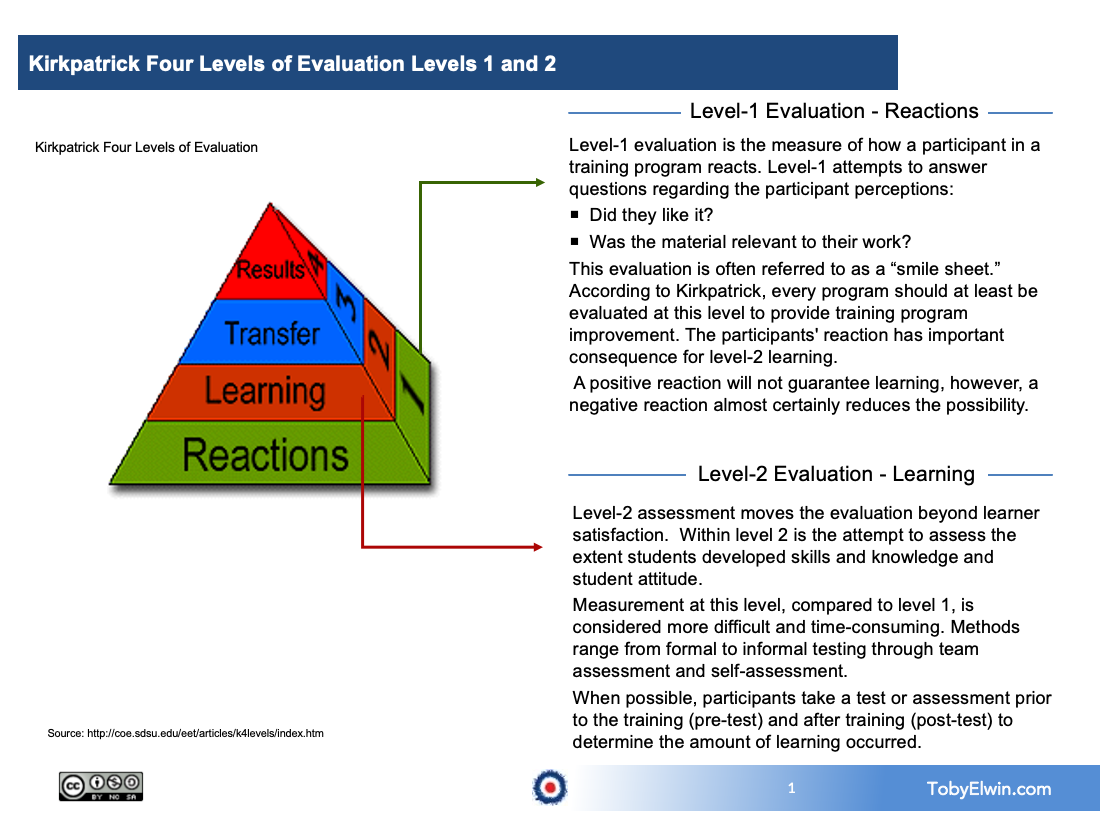
The best learning evaluation I have come across to marry training for business results and measure impact is Kirkpatrick Model. Any trainer worth their salt knows of the Kirkpatrick Model to evaluate demonstrated training business partnership.
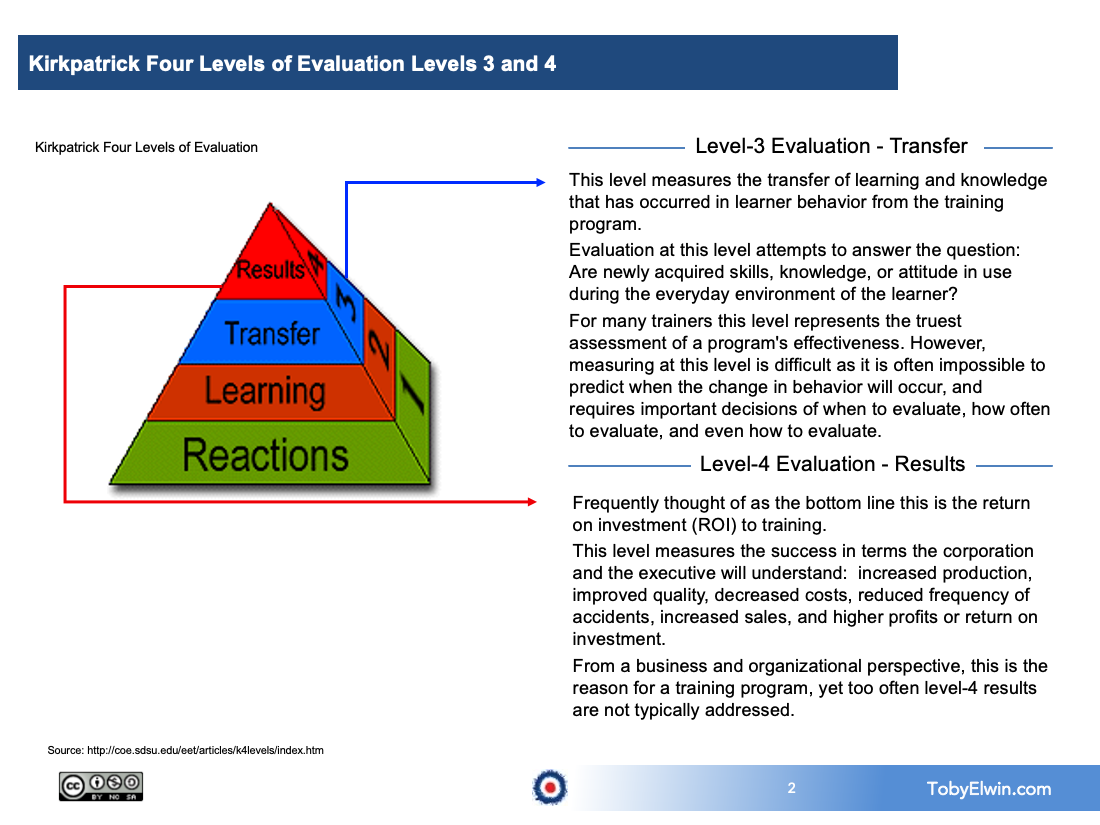
The slides below show detail of each level:
- Level 1: Reaction — To what degree participants react favorably to the training.
- Level 2: Learning — To what degree participants acquire the intended knowledge, skills, attitudes, confidence, and commitment based on their participation in a training event.
- Level 3: Behavior — To what degree participants apply what they learned during training when they are back on the job.
- Level 4: Results — To what degree targeted outcomes occur as a result of the training event and subsequent reinforcement.
Important to note that you need to build Level 1, then 2, then 3, to get to Level 4. Each level below builds ability to meet the next. You can not jump to Level 4: Results without accomplishing Levels 1: Reaction through Level 3: Behavior.
To introduce The Kirkpatrick model you may begin to build programs that accomplish Level 2: Learning, reliably, then as you build awareness of these results add feature elements to accomplish Level 3: Behavior, and so on.
Sources for 2 most important learning metrics:
- How Executives View Learning Metrics Chief Learning Officer magazine
- The ROI Institute
- The Kirkpatrick Partners