In the world of mergers and acquisitions, success doesn’t come easy. Merging two organizations often feels like attempting to fit mismatched fabric colors and patterns. Yet, with the emergence of AI integration, businesses can take an easier, more rational path to realize quicker, post-merger financial value with data fabric.
Gone are the days of extended timelines and ballooning budgets. A modern approach promises to reduce costs with real-time insight that drives operational efficiency and future growth. The fabric of your business, woven with AI, transforms potential headaches into strategic advantages.
- Traditional Integration Cost: $50 million to $150 million, often escalating due to delays and extended consulting engagements
- Artificial Intelligence Cost: $2 million to $5 million, scalable, flexible, with faster benefit
However, all the rosy projections meet reality of integrating two complex organizations. Beyond the celebration and initial buzz of increased market share or assets under management, the process of post-merger integration is hard. Executives may have a legacy-defining deal in mind, but platform consolidation, department restructuring, and system rationalization turns into a drawn-out ordeal.
“Some CEOs see a big acquisition adding short-term sales and profits, the kind of move that will put them on the cover of magazines—for all the wrong reasons,” says A.G. Lafley, special partner at private investment firm Clayton, Dubilier & Rice
The ego-driven push for larger deals often overshadows the delay and high cost to realize synergies. Traditional integration methods rely heavily on consultants, large-scale platform consolidations, and complex change management, all of which can drag out the process and bloat budgets. By the time you get the systems talking, the budget may be spent—and the synergy targets unmet.
The pressure to demonstrate value to achieve economies of scale and enhance operational efficiency leaves executives to look for the next deal over the right deal.
Tradition of Failure
Traditional system integration projects are riddled with costly pitfalls:
- Total Costs: Ranges from $50 million to $150 million, depending on the complexity and number of systems involved.
- Consulting Overhead: Long-term projects often involve hiring outside consultants at steep fees, which can accumulate to $500,000+ per month.
- Delays: Projects regularly overrun their timelines, extending into years instead of months.
- Failure Risks: Systems may never fully integrate, leaving the intended synergies unrealized and the investment underperforming.
The post-merger objective to integrate platforms and bring teams and processes together, ensuring clear communication and reducing operational redundancies. The newly merged organization is to function as a cohesive end-to-end organization, streamlining workflows and unlocking the full potential of combined resources and data.
A new approach to post-merger success leverages AI data integration methods like Data Fabric. Think of AI as the strategic driver that helps rationalize the merger, while Data Fabric serves as the framework that seamlessly connects people, processes, and information across the organization.
At the heart of business operations is a platform—the foundation where applications run. Post-merger playbooks focus on integrating these platforms to optimize how data flows. The merged company’s value depends on bringing teams and systems together through a shared platform to unlock real productivity gains.
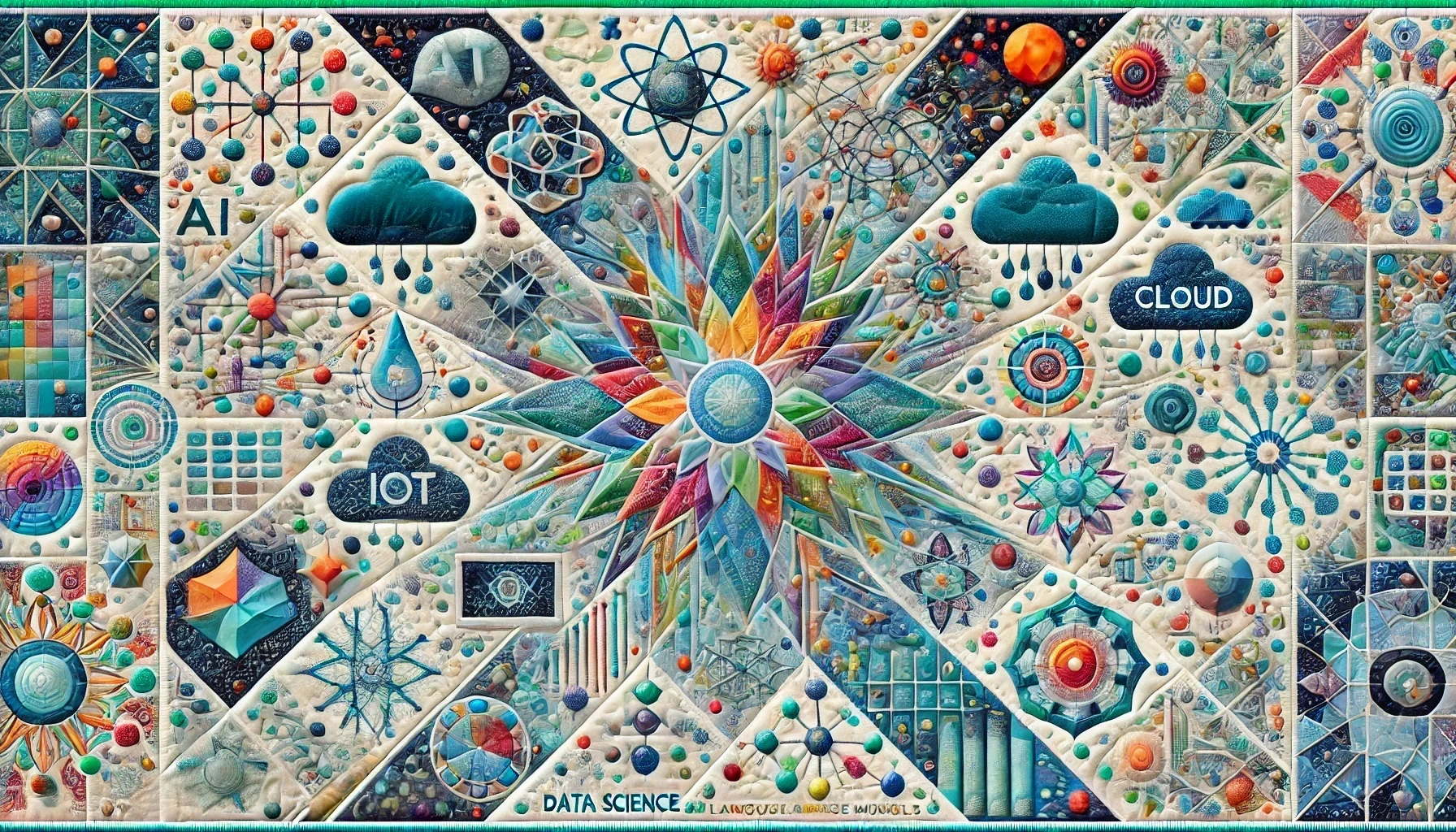
Now, imagine the difference between waiting to patch data across scattered systems versus weaving a seamless quilt from your existing technology data. Data Fabric does the latter, unifying and connecting data without ripping apart the platforms already in place. It’s not just about merging systems; it’s about integrating people and data to drive performance.
In a post-merger world, Data Fabric becomes the architecture that binds your organization. Instead of unraveling your data, Fabric weaves data sources into a unified, powerful input that layers AI, data science, and cloud technologies to drive post-merger success.
Weave Data and People Together for Seamless Synergy
Data Fabric isn’t a product; it’s an architectural approach that enables organizations to access, manage, and govern data effortlessly.
There is a reason for me to introduce Data Fabric into this discussion as a strategic platform solution. Below is an high-level Fabric framework reference:
- Data Fabric (Fabric) unifies data management across platforms and integrates, manages, and governs data in real-time. It connects on-premises, cloud, and hybrid environments into one seamless framework, eliminating complexity.
- Fabric is designed to operate across platforms. It dissolves data silos, creating a flexible and adaptable architecture that spans your organization. Also, whether cloud-based or on-premise, Fabric stitches together disparate systems, providing seamless access to data without the need for full-scale system overhauls.
Rather than draining resources on traditional integration projects, AI and Fabric offer a smarter, more efficient solution. These technologies don’t replace existing systems; they amplify them—binding data and people into a high-performance quilt of seamless operations.
Significantly, a Fabric approach ensures consistency, security, and real-time access to data, regardless of the underlying infrastructure. No need to force system integration and simplifies interoperability over rationalization.
Here’s how AI and Fabric transform the landscape:
- Retrain/Upskill Workforce: Instead of sinking $500,000 to $2 million into change management, invest in training. Equip your workforce to thrive in an AI-driven environment, keeping them engaged and empowered.
- Hire AI and Data Scientists: With salaries ranging from $150,000 to $200,000 per data scientist, a team of five can revolutionize your operations. They automate processes, analyze workflows, and deliver real-time insights.
- Implement Data Fabric: Building a comprehensive Fabric architecture costs anywhere from $500,000 to $5 million. And this investment ensures seamless communication across your systems—without ripping apart the existing technology stack.
Even with salaries in the $250,000 range, the Return On Investment from Fabric and AI-driven improvements is clear: intelligent integration, workforce empowerment, and scalable, real-time performance.
Cost Comparisons: Traditional Integration vs. AI Integration
| Cost Factors | Traditional Integration | AI and Data Fabric ROI |
|---|---|---|
| Consulting Involvement | Multi-year engagement, escalating costs | Shorter, more focused AI-driven projects |
| Delays | Often extends beyond planned timelines | Faster, modular implementations |
| Failure Risk | High risk of partial integration or failure | Lower risk, as systems remain functional |
| People-Centric Approach | Disruptive, requires extensive retraining | Minimal disruption, enhances existing skills |
| Total Cost | $50 million to $150 million | $2 million to $5 million |
The beauty of AI and Fabric lies in their ability to deliver immediate returns, even as your business scales. Instead of waiting for traditional integration methods to catch up, AI can begin generating insights and optimizing processes almost immediately.
- Flexibility and Scalability: As your business grows, AI adapts to new challenges, offering scalable solutions that align with your evolving needs.
- Real-Time Insights: Fabric allows all systems to communicate seamlessly, ensuring employees have the right information at the right time. This empowers smarter, faster decision-making, driving higher productivity and performance.
Traditional integrations focus solely on systems, but Fabric takes it a step further—it integrates people. By making data accessible and actionable in real time, employees can make faster, smarter decisions. No more waiting for platforms to sync or systems to align. Equally, your people are empowered with the information they need when they need it.
As a result, this not just another technological shift, it is a cultural shift. AI and data create an environment where people and technology work in harmony to enhance performance and unlock synergies that traditional integrations simply can’t reach.
Reinventing People, Process, and Technology with AI
Unlike traditional integration methods that focus primarily on technology, AI and Fabric solutions take a more holistic approach to integrate people, data, and process. Employees can access real-time data without waiting for systems to sync, driving more agile business operations.
With AI and Fabric, the total cost of integration drops dramatically and that leaves your organization free to reinvest those savings into growth initiatives. This approach empowers your team to take charge of the post-merger process without being weighed down by outdated systems.
Traditional Integration ROI
- Cost: $50 million to $150 million
- Consulting Firm Involvement: Multi-year integration with escalating fees
- Delays: Projects often overrun, stretching into years
- Failure Risk: Systems may never fully integrate, leaving synergy targets unmet
- Change Management: Disruptive, requiring extensive retraining and system overhauls
AI and Fabric ROI
- Cost: $2 million to $5 million for hiring and building for data architecture
- Outcome: Data scientists and AI automate processes, generate real-time insights, and drive continuous value
- Flexibility: AI solutions are scalable and modular, adapting as your business grows
- Change Management: Your workforce stays engaged and empowered, with minimal disruption to workflows
A note that when I mention change management, I refer to people change manage over the technology change management. Too often across the business landscape technology has coopted change management to mean a technical, linear, rational approach. People, most certainly, are rarely linear or rational.
Data, People, and Performance, a Stitch in Time
The traditional approach to system integration is outdated, expensive, and riddled with delays. Why spend $100 million on a strategy that’s almost certain to disappoint when you can invest a fraction of that in AI and Fabric to create a high-performing, adaptable organization?
Think of it like a quilt with each patch representing a platform, technology, system, department, or process within your organization. While Fabric may seem like random pieces of material with little correlation seemingly disparate pieces come together. The is whole stronger, more flexible, and more capable of presenting new synergies. This new view is faster, less expensive, and without the cost and chaos of traditional integration.
Now, I doubt that Data, People, and Performance will replace the 60-year-old People, Process, and Technology framework trusted by so many for all things problem-solving, change management, and operational excellence.
The future of mergers may not require choosing a Data, People, and Performance or People, Process, and Technology framework, smart companies will blend AI, Big Data, Cloud Computing, and the Internet of Things for systemic digital transformation.
The Quilt of Data Fabric
Digital transformation is integrating people and data-driven ways of working for a rational, performance system.
Fabric is a digital transformation element to enhance traditional processes, consider:
- Cost Efficiency: AI and Fabric slash integration costs by weaving systems together seamlessly.
- Speed: AI provides real-time insights, giving your people the power to act today—not years from now.
- Adoption: Change management costs, from training through new process adoption behaviors.
- Sustainability: AI and Fabric delivery earlier that traditional integrations failure and drive continuous, sustained value.

Blog 1 explored Artificial Intelligence redefines post-merger rationalization to eliminate costly delays.
Blog 2 examined Artificial Intelligence and Data Science to avoid traditional pitfalls.
In this blog, I mean to stitch together the layers in a quilt to form a cohesive whole.
AI and Fabric don’t just integrate systems; they bring people and data into a unified performance fabric, creating a high-efficiency, low-cost approach to mergers.
The current-state of mergers and acquisitions isn’t about sinking fortunes into obsolete platform and technology integration methods.
AI and new ways of working integrations will achieve earlier results that increase the time value of money. And that’s a good return.
*Companies like IBM, Talend, and Informatica provide solutions that support the Data Fabric framework. If you’re interested in learning more about how Data Fabric can help unify your systems and data, it’s worth exploring how these platforms can transform your post-merger strategy.
Post script: all quilt- and fabric-related points are dedicated to my extraordinary mother. Who is also one of the founding members of the New England Quilt Museum in Lowell, Massachusetts. In 1987, her contributions to the quilting community, along with those of other founding members, helped establish the museum as a cultural institution dedicated to preserve and promote the craft of quilting.
There is, however, no link between my mother and Alice Liddell.