SharePoint provides organizations and all who work within them to take knowledge from someone’s hard drive and to a shared forum that …

Below you'll find a list of all posts that have been categorized as “Change Management”
SharePoint provides organizations and all who work within them to take knowledge from someone’s hard drive and to a shared forum that …

We design constantly. Our emails, training courses, project plans, policies, programs, surveys, business cases, strategies, facilitations, we are in a constant state of craft, create, model, test, build, and repair.
Whatever the intent, to take a concept from intention to adoption relies less on what you design and more on how you design.
A community persona perspective measures functional communication design success and reaction to how you design is the feedback loop of how people accept your design.

Constant change relies on constant sharing and I have found Microsoft’s SharePoint application, a powerful enterprise, change management tool.
SharePoint provides multiple ways to build a portal where your organization can not only see latest announcements but participates in discussions and contribute to shared learning. more flexible than formal training and more widely available.
In the last 12 months SharePoint, has radically altered the way I design any change management effort I roll out. Good intranet design with change management efforts to link communication change principles, provide a host of change management options.

SharePoint intranet site design that leaves out understanding user need offers little more than propaganda for what you hope sells.
Hope for a community to buy-in is not much of a strategy.
Conversely, community commitment happens when people return to seek value, exchange value, and contribute value with, and for, each other.
Can you build that? Yes, particularly when you start with a community persona strategy to identify end-user motivations and the transparency to contribute to their need.

Communication is a bridge, on one side is our thought, the other side our audience. The gulf between the two littered with wasted efforts and missed intentions.
What you intend to convey and the view of how your audience reads and reacts reveals the gulf between getting it done versus getting it accomplished. Goal-oriented Design improves the way we think about communication and the channels, the vehicles, and the modes you to create community impact.
Diversity is the spice of life, your work can have greater impact with Goal-oriented Design added to your profession and your work … or continue to build that bridge to nowhere.
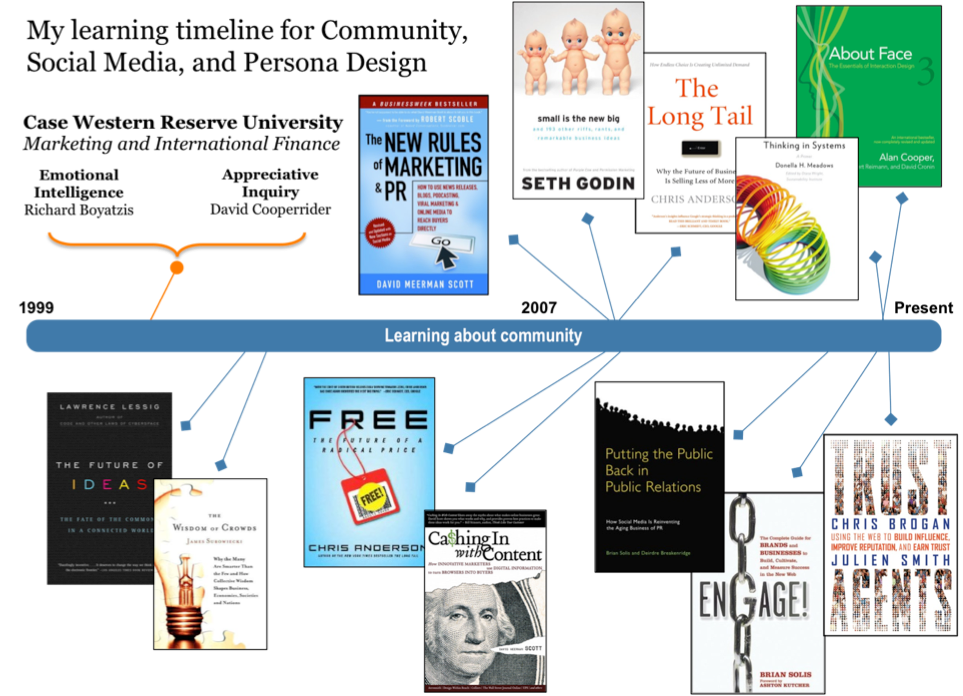
When I presented at the Shifting Role of OD in Business Conference in St. Louis, I showed a visual timeline of sources and influences that led me from organization development into social media.
This image takes you to an expanded view of these influences with direct source links to each.

Since 1955, the Fortune 500 list represents the 500 largest US corporations by gross revenue. Making the Fortune 500 is a mark …

The ability to change comes from the desire to change. The key to positive change is a person’s intrinsic motivation to change. Appreciative Inquiry works around a premise that we move and change in the direction we inquire.

OK, Information Technology, you win. You can have it. You’ve ruined it beyond recognition anyway. Only left me a shell of a …

In business we constantly design. By design I include that we design meetings, we design strategy, we design communication, we design training, and we design projects and programs.
Some design efforts, such as strategy, business process re-engineering, or talent engagement initiatives, may result in new processes, new standards, or new tasks, but the design goal remains: adoption and utility.

Why do people matter? Because people are the only way organizations, and communities, achieve or sustain anything. To understand people you need to understand what answers they look for.
Clear links from content to the place where action occurs is crucial. To move from selling to solving means a move from your motivation to get it done to another’s motivation to solve a challenge. Persona strategies create marketing goals more effective than traditional advertising.

The technical skills, frameworks, and tools that HR and organization development rely on to understand, communicate, and motivate interventions for people and organizations needs a reboot. A relaunch. A restart. This starts with a peek outside their profession: enter marketing, with a social media twist.
The persona effort, based on the usability and goal-oriented design, is a superior framework to plan, launch, guide, monitor, and manage organization interventions and change management initiatives than many organization development frameworks.

Market change, economy change, technology change, workforce change, communication change, today change riddles stress cracks in organization foundations. Whether 80-year-old companies, Fortune …

Companies develop their own language or accepted terms. Professions develop their own lingo. Organization development clichés are just as tired as all …

“A rose by any other name would smell as sweet … “, iambic pentameter aside, I appreciate Mr. Shakespeare’s point.
However, when I look at a word that is recently trending in a lot of companies and organizations, a word such as … oh, engagement, it seems to stink of some fetid cesspool, not quite the rose implied.
The value of context relies on engagement. Context without perspective is an allusion. Without context what is said rarely meets what is delivered.

Change is fun for some: the energy of the unknown, the passion instilled in people looking forward to a new adventure. …

The success, or failure, of organization change may have more to do with the frame of change you and your leadership …

A leader’s job is to not create a space that causes so much pain that people must move, but to create a compelling future vision people are drawn to.
If leadership starts their focus on what did not work or what you do not want to happen then effort goes into putting procedures in place that constrain. If leadership focus starts on what worked or what it looks like when it worked and the focus shifts to how it worked to and what is achievable, what is possible.
Appreciative Inquiry, as a principle for design and change management, allows organizations to change the focus. Where we inquire, we move and Appreciative Inquiry changes the change.